Which insulation material are you considering?
No votes yet. Yours will be the first. · saved on this device
Loading...
Home Energy Scope · Insulation & Air Sealing cost guide
Attic insulation averages about $2,100 in 2026 per HomeAdvisor, with a typical range of $1,700 to $2,500. Blown-in projects average $1,661 and spray foam $2,888. By area, Block Renovation prices a 1,000 sq ft attic at $1,500 to $3,000 and a 1,500 sq ft attic at $2,000 to $4,500 installed. Air sealing adds $200 to about $1,500. HEAR rebates cap insulation and air sealing at $1,600 where state programs are open.
Insulation is priced by area and depth, and air sealing by time. That difference matters, because a bid that looks cheap per square foot may have left out the sealing that delivers most of the savings. This page breaks down costs by material, per-unit rates, labor share, add-ons, what to cut and what not to, and sample budgets for three common houses.
The cost table on this page lists typical line items. For materials and methods, see the insulation and air sealing page, and for how this fits a whole-house budget, see the retrofit cost guide. Prices below are national and before rebates; local labor rates, climate targets and attic conditions will move them, sometimes substantially, in either direction.
| Item | Low | High | Unit | Notes |
|---|---|---|---|---|
| Attic insulation, installed | $1,700 | $2,500 | flat | HomeAdvisor 2026, avg $2,100 |
| Blown-in insulation project | $987 | $2,334 | flat | HomeAdvisor 2026, avg $1,661 |
| Spray foam project | $1,455 | $4,337 | flat | HomeAdvisor 2026, avg $2,888; attics up to $9,000 |
| Insulation material | $1 | $5 | per sq ft | By material |
| Installation labor | $1.5 | $3 | per sq ft | HomeAdvisor |
| Attic air sealing | $300 | $1,500 | flat | Top plates, penetrations, hatch |
| Rim joist spray foam | $500 | $2,000 | flat | |
| Blower door test-out | $150 | $450 | flat | Fixr |
A 1,500-square-foot attic costs about $2,000–$4,500 to insulate, according to Block Renovation's July 2026 guide, and a 1,000-square-foot attic about $1,500 to $3,000. The attic-size table in this section, from the same guide, shows how the range widens as area grows: bigger attics leave more room for the choice between a loose-fill top-up and a full spray foam job to move the total.
Floor area of the attic is usually close to the footprint of the top floor, not the home's total square footage, so a 2,000-square-foot two-story house often has an attic near 1,000 square feet. These ranges assume the attic is reachable and the old material can stay. Block adds $1 to $2 per square foot for removal and $200 to $1,500 for air sealing when those are needed.
| Attic floor area | Typical installed cost (Block Renovation, July 2026) |
|---|---|
| 500 sq ft | $800 to $1,500 |
| 1,000 sq ft | $1,500 to $3,000 |
| 1,500 sq ft | $2,000 to $4,500 |
| 2,000 sq ft | $3,000 to $7,000 |
Block Renovation's 2026 installed prices, which include labor, run from $0.80 per square foot for fiberglass batts to $5 for spray foam; the material table in this section lists each one with the R-value per inch from DOE's Guide to Home Insulation and its Building America spray foam guide. HomeAdvisor splits the same work into material at $1 to $5 per square foot and labor at $1.50 to $3, and prices spray foam per board foot: $0.60 to $1.60 open-cell and $1.30 to $3.10 closed-cell.
Project averages tell a similar story. HomeAdvisor's 2026 averages are $2,100 for attic insulation, $1,661 for a blown-in project and $2,888 for spray foam, with foamed attics ranging from about $1,100 to $9,000 depending on size and thickness. The gap between the blown-in and spray foam averages is mostly material and equipment rather than labor, which is why foam is hard to justify on a plain, open attic floor that loose-fill can cover well.
| Material | Installed $/sq ft (Block Renovation, 2026) | R-value (DOE) |
|---|---|---|
| Fiberglass batts | $0.80 to $2.50 | R-13 at 3.5 in, about R-3.7 per inch |
| Blown-in fiberglass | $1 to $2.50 | Loose fill: R-30 to R-50 at 8 to 23 in, by material and density |
| Blown-in cellulose | $1.20 to $3 | Loose fill: R-30 to R-50 at 8 to 23 in, by material and density |
| Mineral wool | $1.50 to $3 | Loose fill: R-30 to R-50 at 8 to 23 in, by material and density |
| Spray foam | $1.50 to $5 | Open-cell about R-3.6 per inch; closed-cell about R-6 to R-6.5 per inch |
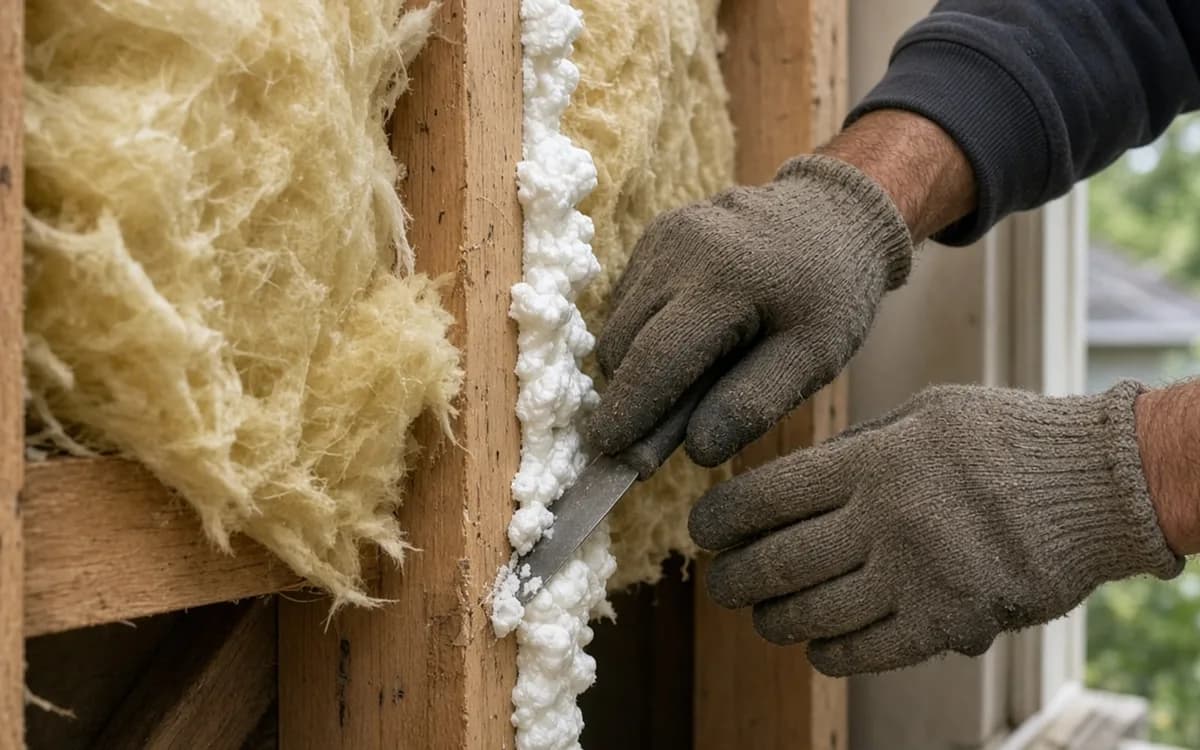
Air sealing is labor: a technician in the attic with foam, caulk, rigid board and sheet metal, sealing top plates, penetrations, chases and the hatch. The site's cost table lists attic air sealing at $300 to $1,500 depending on attic size and complexity. Rim joist sealing with spray foam is a separate line at $500 to $2,000.
Because the materials are cheap and the work is invisible once insulation covers it, sealing is the easiest line for a low bidder to shorten or skip. Yet ENERGY STAR's 15% savings estimate assumes sealing plus insulation. Ask for sealing as its own line with a list of locations, and verify it with a blower door test-out, which Fixr prices at $150 to $450 standalone.
Most extras come from conditions in the attic. Removing old insulation that is wet, moldy or contaminated adds removal labor and disposal. Vermiculite must be tested for asbestos before disturbance. Bath fans that vent into the attic need ducting to the outside. Eave baffles keep insulation from blocking ventilation. Insulated hatch covers and dams around chimneys and non-IC recessed lights add small amounts each.
Labor is a large share of insulation work. On HomeAdvisor's per-square-foot figures, labor at $1.50 to $3 can equal or exceed material for blown-in. Blown-in crews bill about $40 to $70 an hour. Air sealing is almost entirely labor. Spray foam's material cost is higher, so labor is a smaller share, but the equipment and training raise the hourly rate.
Timeline affects labor. A typical attic seal-and-blow takes one day, sometimes two. Difficult access, low-slope roofs and heavy debris lengthen it. Busy fall seasons can push schedules out, and rebate pre-approval adds calendar time without adding cost. Scheduling in spring or summer, outside the heating-season rush, can shorten waits. Time on site is what you pay for, so access matters.
Through 2025, the IRS 25C credit covered 30% of insulation and air sealing materials within its annual cap of 30% up to $3,200, but it ended for property placed in service after December 31, 2025. For 2026 work, state programs are the main source. Trane's summary of HEAR lists caps of $8,000 heat pump / $1,600 insulation, with income-based coverage up to the full cost for lower-income households.
Utility programs often offer per-square-foot or per-project insulation rebates and may require a participating contractor and a test-out. The DOE's Weatherization Assistance Program, reported to save households $372/yr, covers insulation at no cost for eligible households. Check the rebate poll and your state energy office before scheduling. Pre-approval rules mean the order of steps matters.
Budgets are tight for many owners: Angi's 2025 Home Spending Pulse found 62% of homeowners who hired a pro reported growing concern about affording maintenance. If that is you, reduce the scope by area, not by quality. Seal and insulate the main attic fully and leave a small bonus-room knee wall for later. Choose blown-in over spray foam for an open attic floor. Skip radiant barriers outside hot climates. Defer wall insulation unless the audit shows it is a major loss.
Never cut air sealing, baffles, combustion safety checks when gas appliances are present, or the test-out. Those items are what make the insulation work and keep the house safe. A job that installs deep insulation over an unsealed attic floor spends most of the money and captures much less of the savings.
These examples use HomeAdvisor's 2026 figures and the site's cost table, before rebates. They assume adding over existing material and no removal; the 2.6% of homes our EIA 2024 analysis finds described as uninsulated start from bare joists and cost more. Use the blown-in versus spray foam comparison to decide the material. Add ten to fifteen percent contingency for older homes where removal, vermiculite testing or wiring evaluation may be needed once the attic is opened.
| House | Scope | Estimated budget |
|---|---|---|
| 1,200 sq ft ranch attic | Air sealing plus blown-in to R-49 | About $1,500 to $2,800 |
| 2,000 sq ft two-story | Attic sealing, blown-in, rim joist foam, test-out | About $3,000 to $5,500 |
| 2,000 sq ft, ducts in attic, hot climate | Roof-deck spray foam, duct sealing | Several thousand dollars, up to about $9,000 |
The same attic costs more to insulate in a cold climate because the target is higher. ENERGY STAR's climate-zone table, reproduced in this section, sets R-60 for an uninsulated attic from zone 4 north and R-30 in zone 1, the warmest zone, so a northern job uses roughly twice the material over the same floor area. Labor rises less than material, because sealing and setup take about the same time regardless of final depth. Expect cold-climate bids to sit toward the upper end of HomeAdvisor's ranges for that reason.
Local labor rates add a second layer. Metro areas on both coasts tend to price above national averages, and rural jobs may include travel charges. In hot-humid regions, the scope often shifts toward duct sealing and roof-deck foam when ducts run through the attic, which changes the price more than the climate target does. Our analysis of EIA 2024 data shows 20.6% of Northeastern homes described as poorly insulated, which is one reason sealing and insulation dominate retrofit budgets there.
| IECC climate zone | Uninsulated attic (ENERGY STAR) | Attic with 3–4 in existing (ENERGY STAR) |
|---|---|---|
| Zone 1 | R-30 | R-25 |
| Zones 2 and 3 | R-49 | R-38 |
| Zones 4 to 8 | R-60 | R-49 |
By the numbers
Planning figures from published U.S. sources; every card links to where the number came from.
$2,100
average attic insulation cost, range $1,700–$2,500; $1–$5 per sq ft by material
HomeAdvisor lists blown-in at $1–$4 per square foot, batts $2–$4 and spray foam $2–$5, with labor $1.50–$3 per square foot on top of materials.
HomeAdvisor, Attic Insulation Cost (2026)$1,661
average blown-in insulation project, typical $987–$2,334
Fiberglass blown-in runs $0.50–$1.10 per square foot in material versus $2.00–$2.30 for dense-pack cellulose, per HomeAdvisor, with labor $40–$70 per hour.
HomeAdvisor, Blown-In Insulation Cost (2026)$2,888
average spray foam insulation project, range $1,455–$4,337; attics $1,100–$9,000
HomeAdvisor prices open-cell at $0.60–$1.60 and closed-cell at $1.30–$3.10 per board foot. Spray foam air-seals as it insulates but costs more than fiberglass batts ($300–$1,500).
HomeAdvisor, Spray Foam Insulation Cost (2026)$8,000 heat pump / $1,600 insulation
HEAR item caps: heat pump $8,000, panel $4,000, HPWH $1,750, insulation and air sealing $1,600
Trane's summary of DOE program rules lists per-item maximums and income tiers: households under 80% of area median income can get up to 100% of cost, 80–150% AMI up to 50%.
Trane, New DOE Heat Pump Rebates (2024)The calculator uses the same home energy improvements benchmarks as this guide. Set the size and tier, then request a written estimate to check it against a real proposal.
Homeowner polls
No votes yet. Yours will be the first. · saved on this device
No votes yet. Yours will be the first. · saved on this device
Flat prices bundle area, sealing, baffles and testing into one number; per-square-foot quotes often cover only the insulation. Neither is wrong, but you need to convert both into the same list of items to compare. Ask the flat-price bidder for a breakdown and the per-foot bidder for a list of what is excluded.
Block Renovation's July 2026 guide puts a 1,500-square-foot attic at $2,000–$4,500 installed. The low end is a loose-fill top-up over existing material; the high end reflects spray foam, deeper cold-climate targets or difficult access. Removal adds $1 to $2 per square foot if the old material has to come out, and air sealing should be priced as its own line.
Going from R-49 to R-60 adds a few more inches of loose-fill, so the material cost rises roughly in proportion while setup and sealing costs stay the same. The added savings are smaller than those from the first inches. ENERGY STAR sets R-60 for an uninsulated attic in climate zones 4 through 8, but R-49 where 3 to 4 inches already exist; in zones 2 and 3 the uninsulated target is R-49.
Dense-pack cellulose in closed walls costs more per square foot than attic loose-fill because it requires drilling, packing at high density and patching holes. HomeAdvisor lists dense-pack cellulose material at about $2.00 to $2.30 per square foot before labor. It is worth considering in uninsulated walls; the EIA found households describe only 2.6% of homes as uninsulated overall.
Yes. The EPA advises not disturbing vermiculite that may contain asbestos until it is tested. If testing finds asbestos, removal by a licensed abatement contractor is a separate, significant cost. Some homeowners choose to leave it undisturbed and insulate other areas instead. Get the test results before accepting any bid that involves the attic floor.
Often, because crawlspaces are cramped, may need moisture control first and sometimes involve encapsulation with a vapor barrier and sealed vents. Closed-cell foam on crawlspace walls is common in cold climates. The site does not have a sourced crawlspace range, so compare bids carefully and ask what moisture work is included.
Usually yes, which is one of the hidden financial benefits of doing the envelope first. HomeAdvisor averages heat pump installation at $6,088, and capacity drives price. A proper load calculation after the envelope work can reduce the size needed and the cost of the system.
It depends on climate, fuel prices and how poorly insulated the attic was. ENERGY STAR's 15% average heating and cooling savings, applied to a typical bill that ENERGY STAR puts near $1,900 a year with nearly half for heating and cooling, gives a sense of scale. Poorly insulated homes in cold climates see the fastest payback.
 Home Energy Audits · Cost guideHome energy audit cost in 2026: what each tier and test adds
A home energy audit costs about $212 to $698 in 2026, with Angi and HomeAdvisor both putting the average near $437.
 Window & Door Replacement · Cost guideWindow and door replacement cost in 2026, per opening and for the whole house
Window replacement averages about $800 per window in 2026 per Fixr, typically $450 to $1,200, and a whole-home project averages $7,347 per HomeAdvisor, ranging from $3,436 to $11,837.
 Solar Panel Installation · Cost guideSolar panel installation cost in 2026, per watt and per system
Solar costs about $2.60 per watt in 2026 per EnergySage, or about $31,135 for a 12 kW system before incentives.
 Service guideInsulation & Air Sealing
Air sealing closes the gaps that move air through the attic plane, rim joist and penetrations; insulation slows heat conduction through the assemblies around them.
Service guideHome Energy AuditsA home energy audit connects comfort complaints and utility bills to the measured condition of the house through a blower door test, thermal imaging, duct leakage testing and combustion-safety checks, then delivers written, prioritized recommendations.
Service guideWindow & Door ReplacementWindow and door replacement addresses openings with a defined problem: damage, failed seals, poor operation, drafts, single-pane glass in a cold climate, or a door that leaks and does not latch.
 Free toolEnergy audit cost calculator: size the assessment before the retrofit
Size, material tier and complexity in, a realistic budget range out.
 Free toolEnergy retrofit comparisons: the five decisions inside a retrofit
Side-by-side tables for the decisions that change the price most.
 Free toolEnergy retrofit readiness quiz: do you know the sequence and the tests?
10 questions that show what you already know and what to check next.
 Free toolEnergy retrofit polls: how other homeowners weighed the same decisions
See what other planners chose and add your vote.
Tell us the size, the condition of what is there now, and what you want to change. Home Energy Scope passes your request to independent local professionals, who reply with written, no-obligation estimates. The service is free to use.