Have you had a professional energy assessment?
No votes yet. Yours will be the first. · saved on this device
Loading...
Home Energy Scope · Service guide
A home energy audit connects comfort complaints and utility bills to the measured condition of the house through a blower door test, thermal imaging, duct leakage testing and combustion-safety checks, then delivers written, prioritized recommendations. It suits any home with unexplained drafts, uneven rooms or high bills, and any home about to be tightened. Typical cost is $212 to $698.
An audit is the cheapest step in a retrofit and the one that decides whether the rest is money well spent. Pearl Certification's 2026 statistics, citing Angi data, report homeowners save about $685/yr by acting on audit findings, against an average audit cost of $437, and that a professional finds about 35 problems where a DIY walk-through finds 12. The difference is instruments: a blower door measures what a flashlight cannot.
Not every audit is equal. A basic walk-through with a checklist costs $150 to $200 and produces generalities. A diagnostic audit with a blower door, thermal camera, duct test and combustion-safety check costs more and produces numbers a contractor can be held to. This page explains what each includes, what the report should contain, how utilities subsidize the work, and what to ask before booking one through matched local professionals.
Want the numbers only? Read the home energy audits cost guide for 2026 ranges, what moves the price, and sample budgets.
| Item | Low | High | Unit | Notes |
|---|---|---|---|---|
| Basic walk-through assessment | $150 | $200 | flat | HomeAdvisor |
| Standard diagnostic audit | $212 | $698 | flat | Angi 2026 benchmark, avg $437 |
| Full audit with all tests | $500 | $900 | flat | HomeAdvisor |
| Blower door test alone | $150 | $450 | flat | Fixr |
| Thermal imaging | $150 | $250 | flat | HomeAdvisor ~$200 |
| Duct leakage test | $100 | $150 | flat | HomeAdvisor ~$100 |
| Post-work test-out | $150 | $350 | flat | Verifies air sealing results |
A diagnostic audit is worth its cost when the house has symptoms with no obvious cause: rooms that will not hold temperature, bills far above neighbors', ice dams, condensation, or a draft nobody can locate. Our analysis of the EIA's 2024 household survey found 13.8% of occupied homes drafty most or all of the time and 17.6% described as poorly insulated. Age alone does not settle it: frequent draftiness in owner-occupied homes built before 1990 runs 12.3% against 5.8% for newer ones, a 6.5 pts gap, so most older houses are not constantly drafty and some newer ones are. Those households need measurements, not a checklist.
A walk-through suffices when the problem is visible and singular, such as an attic with three inches of insulation and daylight around the hatch, or when a utility offers it free as a first step. Even then, ask for a blower door before any air sealing so the contractor has a baseline. The quiz helps you decide which tier fits, and the insulation page explains why sealing without a test is guesswork.
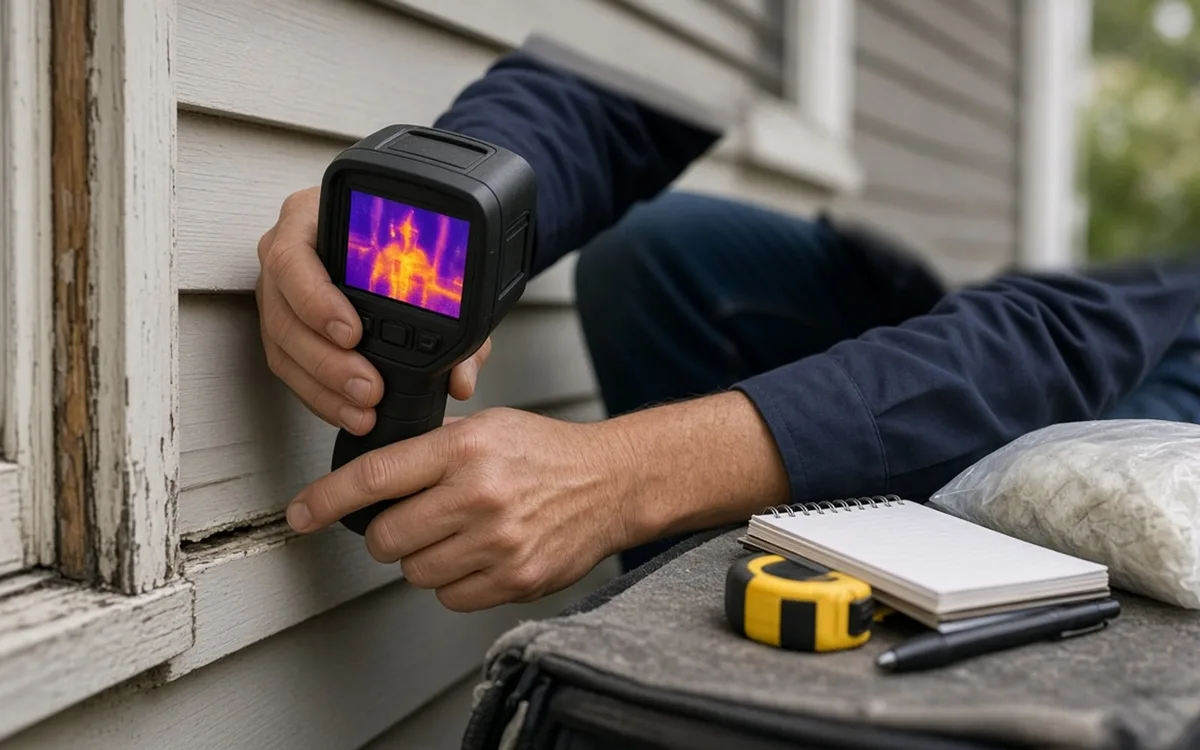
The blower door depressurizes the house with a calibrated fan and reports leakage in cubic feet per minute at 50 pascals, which lets the auditor compare your house to standards and find the paths with a smoke pencil while the fan runs. Thermal imaging shows missing insulation, wet areas and air paths as temperature differences. A duct leakage test pressurizes the duct system and reports how much conditioned air escapes; in homes with ducts in attics or crawlspaces the loss is often 20 to 30%.
Combustion safety testing checks whether gas appliances draft properly and whether carbon monoxide is present, before and after the house is tightened. It is the test most often skipped and the one that prevents harm. HomeAdvisor prices the components at roughly $350 for a blower door, $100 for a duct test and $200 for thermal imaging within a full audit of $500 to $900. Ask which of these are included in any quoted price.
| Test | What it measures | Why it matters | Typical add-on cost |
|---|---|---|---|
| Blower door | Whole-house air leakage (CFM50) | Baseline and target for air sealing | $150–$450 (Fixr), ~$350 (HomeAdvisor) |
| Thermal imaging | Surface temperature differences | Locates missing insulation, moisture, air paths | ~$200 (HomeAdvisor) |
| Duct leakage | Conditioned air lost from ducts | Often 20–30% in attic or crawlspace ducts | ~$100 (HomeAdvisor) |
| Combustion safety | Appliance draft, CO, spillage | Required before tightening a home with gas appliances | Often included; ask |
Angi's 2026 benchmark is $437 on average with a typical range of $212 to $698, and HomeAdvisor's June 2026 figure is $437. Fixr's national average for a standard audit on a 1,200 square foot home is $250, with blower door testing at $150 to $450 on its own. Home size, number of stories, number of HVAC systems and the diagnostic scope move the price. The calculator on this site scales those factors.
Utilities are the usual subsidy. Many offer free or reduced-cost assessments through demand-side management programs, sometimes with free air sealing and LED bulbs included. By our analysis of EIA 2024 data, LEDs already fill at least half the sockets in 74.8% of homes, but only 36.7% are all-LED and 10.3% use none. The federal 25C credit allowed $150 for an audit through property placed in service by December 31, 2025; 2026 audits do not qualify. Check your utility first, then state programs, then pay retail.
Numbers, priorities and dependencies. The blower door result with a target after sealing; thermal images annotated with location and finding; duct leakage as a percentage; combustion-safety results for each appliance; insulation levels by location against recommended R-values; and a prioritized list of measures with estimated cost, estimated savings and the assumption behind each. A report that recommends a product without a measured condition behind it is a sales document.
The report should also flag what must happen first. If the water heater backdrafts, that precedes any tightening. If the attic has knob-and-tube wiring, insulation cannot go over it until an electrician addresses it. If moisture is found, the source is fixed before insulation seals it in. These dependencies are what a diagnosis adds over a quote, and they are the reason to keep the report as the plan for later work.
A diagnostic audit takes two to four hours on site for a typical house. The auditor reviews twelve months of utility bills and your comfort complaints, walks the exterior and every room, inspects the attic, basement or crawlspace and mechanical equipment, sets up the blower door, scans with the thermal camera while the house is depressurized, tests ducts and combustion appliances, and photographs findings. The report usually follows within a week.
Prepare by gathering bills, listing the rooms that are hot, cold, drafty or damp, noting previous work, and clearing access to the attic hatch, electrical panel and mechanical room. Fireplaces should be cold and ashes covered before a blower door test. Pets and small children are best elsewhere during the fan test. The contact page lists what to include in a request so auditors can quote the right scope.
Hiring an auditor who sells one product, so every finding points to that product. Accepting a walk-through when the symptoms call for instruments. Skipping combustion safety in a house with gas appliances. Ignoring the sequence in the report and buying the largest item first. And losing the report, which is the baseline every later contractor should be tested against. Pearl's registry analysis found air leakage problems in ~90% of homes; an audit that does not measure leakage has missed the most common finding.
Cold climates emphasize the attic plane, ice dam paths and rim joists; the EIA found the Northeast reports the highest share of homes drafty most or all of the time at 17.2% and the highest share described as poorly insulated at 20.6%. Hot-humid climates emphasize duct leakage in attics, attic ventilation and moisture; the South has the most attics at 55.3% of homes. Dry western climates emphasize cooling loads and shading. A good auditor adjusts the report's priorities accordingly, and the locations page summarizes regional conditions.
Ask each provider which tests are included at the quoted price, what credentials the auditor holds, whether the report includes measured numbers and prioritized measures with assumptions, whether they sell installation services and how they handle that conflict, and whether a post-work test-out is offered. Compare the scope rather than the price; a $200 checklist and a $600 diagnostic audit are different products. RESNET reports 436,798 homes received a HERS score in 2024, and if resale is a goal, ask whether the auditor can rate the home afterward.
Homeowner polls
No votes yet. Yours will be the first. · saved on this device
No votes yet. Yours will be the first. · saved on this device
No votes yet. Yours will be the first. · saved on this device
 Service guideInsulation & Air Sealing
Air sealing closes the gaps that move air through the attic plane, rim joist and penetrations; insulation slows heat conduction through the assemblies around them.
 Service guideWindow & Door Replacement
Window and door replacement addresses openings with a defined problem: damage, failed seals, poor operation, drafts, single-pane glass in a cold climate, or a door that leaks and does not latch.
 Service guideSolar Panel Installation
Solar panel installation covers the roof and shading assessment, equipment selection, electrical and structural permits, utility interconnection and the production and financial assumptions in the proposal.
It depends on house size and climate, which is why auditors report air changes per hour at 50 pascals (ACH50) as well as CFM50. Older leaky homes often test above 10 ACH50; a well-sealed existing home lands around 3 to 5; new construction codes in many states require 3 or 5 depending on climate zone. Ask the auditor for your number, the target after sealing, and the point at which mechanical ventilation becomes necessary.
Many home performance contractors do both, which gives you one accountable party but creates an incentive to find insulation problems. If you use one company, insist on the blower door number before and after, the combustion-safety result, and a written note on findings they do not address. If the budget allows, an independent audit followed by competitive bids is the cleaner path.
Usually not. A HERS rating is a standardized index produced by a RESNET-certified rater using modeling software, most common on new homes, while an audit is a diagnostic visit that produces recommendations. Some raters offer both. If you want a score for resale, ask specifically, and expect a separate fee; RESNET reports the average 2024 rated home scored 55.
Some are excellent and include a blower door and direct-install measures; others are checklist walk-throughs designed to enroll you in rebate programs. Ask the utility which tests are performed and whether a written report with measured results is provided. A free walk-through is still a reasonable first step, followed by a paid diagnostic audit if the findings are vague.
Gather twelve months of utility bills, list the rooms with comfort problems, note prior insulation or window work, and clear access to the attic hatch, electrical panel, water heater and furnace. Make sure fireplaces are cold with ashes covered, and plan for pets to be out during the blower door test. Have your questions ready; the auditor's explanations during the visit are often as useful as the report.
Yes, with a temperature difference between inside and out of roughly 15 degrees or more, which a hot afternoon with air conditioning running provides. The camera shows heat entering through missing insulation and air paths just as it shows heat leaving in winter. Very mild days are the problem; a good auditor schedules around them or uses the blower door to create the pressure difference.
BPI Building Analyst or Building Analyst Technician for diagnostic audits, and RESNET HERS Rater for ratings, are the recognized credentials. Some states license home energy auditors or require specific certifications for utility programs. Ask for the certificate number and check it with the certifying body. Credentials do not replace a clear report, but they do indicate training on blower door and combustion-safety protocols.
There was. The federal 25C credit allowed 30% of the cost of a qualified home energy audit up to $150, for audits performed by a qualified auditor with a written report, through property placed in service by December 31, 2025. Audits performed in 2025 can be claimed on 2025 returns. Audits in 2026 do not qualify; look to utility subsidies and state programs instead.
 Free toolEnergy audit cost calculator: size the assessment before the retrofit
Size, material tier and complexity in, a realistic budget range out.
 Free toolEnergy retrofit comparisons: the five decisions inside a retrofit
Side-by-side tables for the decisions that change the price most.
 Free toolEnergy retrofit readiness quiz: do you know the sequence and the tests?
10 questions that show what you already know and what to check next.
 Free toolEnergy retrofit polls: how other homeowners weighed the same decisions
See what other planners chose and add your vote.
Tell us the size, the condition of what is there now, and what you want to change. Home Energy Scope passes your request to independent local professionals, who reply with written, no-obligation estimates. The service is free to use.