What is your main reason for considering solar?
No votes yet. Yours will be the first. · saved on this device
Loading...
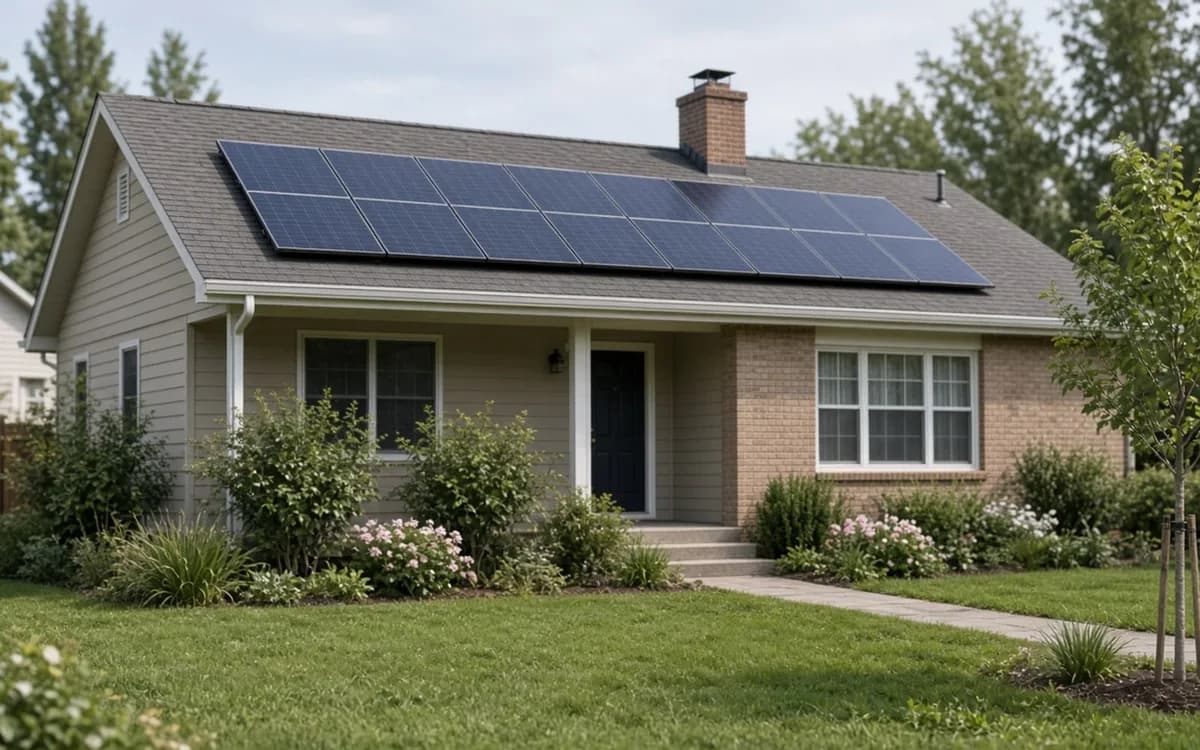
Home Energy Scope · Service guide
Solar panel installation covers the roof and shading assessment, equipment selection, electrical and structural permits, utility interconnection and the production and financial assumptions in the proposal. It suits homes with a sound roof, good exposure and an envelope that has already been tightened. At about $2.60 per watt in 2026 and no federal credit, payback averages around ten years and depends on local rates.
Solar is the largest single energy purchase most homeowners make, and the one whose proposal contains the most assumptions. EnergySage's June 2026 data puts the average cost at $2.60/W, or about $31,135 for a 12 kW system before incentives, with panels only about 12% of the price; labor, inverters, racking, permits and sales costs are the rest. The 30% federal credit ended for property placed in service after December 31, 2025, so 2026 proposals must show their math without it.
This page explains how to evaluate that math: the roof and shading assessment, the production estimate and what it assumes, utility net-metering rules, equipment and warranties, batteries, and what the resale data actually shows. It also explains why solar belongs after envelope work, since every kilowatt-hour removed by insulation is a panel you do not buy. Matched local installers provide free written proposals.
Want the numbers only? Read the solar panel installation cost guide for 2026 ranges, what moves the price, and sample budgets.
| Item | Low | High | Unit | Notes |
|---|---|---|---|---|
| Solar system, installed | $2.3 | $3.2 | per watt | EnergySage 2026 average $2.60/W |
| 6 kW system | $14,000 | $19,000 | flat | |
| 12 kW system | $28,000 | $38,000 | flat | EnergySage example $31,135 |
| Battery storage | $10,000 | $20,000 | flat | By capacity and backup scope |
| Main panel upgrade | $1,500 | $4,000 | flat | HEAR rebate up to $4,000 where launched |
| Panel removal and reinstall for roofing | $2,000 | $5,000 | flat | |
| String inverter replacement (year 10–15) | $1,500 | $3,000 | flat |
The strong candidate has a roof with at least ten to fifteen years of life left, a south-, west- or east-facing plane with little shade, an electric bill that stays high after envelope work, and a utility with net metering or a reasonable export rate. The candidate who should wait has a roof due for replacement, heavy tree shade, a small bill, or an envelope that the audit shows is still leaking. Zillow's 2025 trends report found solar in +18% more listings than the previous year, so interest is up, but interest is not fit.
Sequence matters financially. A home that cuts its load 15% through sealing and insulation needs a system roughly 15% smaller, which at $2.60 per watt on a 10 kW system is about $4,000 saved before the first panel goes up. Lighting belongs in the same pass: by our analysis of EIA 2024 survey data, only 36.7% of homes are all-LED indoors and 8.6% leave incandescent or halogen outdoor bulbs on all night, both cheaper to fix than panels. A heat pump or EV charger added later raises the load, so tell the installer what is coming.
EnergySage's national average is $2.60 per watt installed, so a 6 kW system runs about $15,600 and a 12 kW system about $31,135 before any state or utility incentive. The per-watt figure falls slightly with system size and rises with roof complexity, steep pitches, tile or metal roofing, long conduit runs, a main panel upgrade, and premium panels or microinverters. Batteries add roughly $10,000 to $20,000 depending on capacity.
Payback follows local electricity rates and export rules more than equipment. EnergySage reports an average payback near ten years and 25-year savings of $41,000 to $155,000 across markets, a range that reflects rates from under 12 cents to over 30 cents per kilowatt-hour. ACEEE's 2026 analysis estimates efficiency and heat pumps could cut U.S. energy costs $215B/yr, with about half from buildings; solar sits on top of that envelope-first math. The calculator covers the assessment stage.
| System | Approximate 2026 cost at $2.60/W | Notes |
|---|---|---|
| 6 kW | $15,600 | Small home, tightened envelope |
| 8 kW | $20,800 | Typical suburban home |
| 10 kW | $26,000 | Larger home or electrification plans |
| 12 kW | $31,135 (EnergySage example) | Large home, EV, heat pump |
| Battery add-on | $10,000–$20,000 | Backup and rate arbitrage |
Every proposal contains a production estimate in kilowatt-hours per year. Ask what it assumes: roof azimuth and tilt, shading losses from a site survey rather than a satellite guess, panel degradation of roughly 0.5% per year, inverter efficiency, soiling, and snow. Then ask what utility rate and escalation it uses, whether net metering credits at retail or export at a lower rate, and whether the rate plan changes when you go solar. A 3% annual rate escalation assumption over 25 years roughly doubles projected savings versus 1%.
Compare the estimate to your last twelve months of usage. A system sized to produce 120% of usage in a market with poor export rates is oversized; one at 60% may leave money on the table under full net metering. Tools such as NREL's PVWatts let you check the production number independently. A proposal that will not state its assumptions has not earned the deposit.
The roof should be inspected for remaining life, and if it is within ten years of replacement, replace it first or price the removal and reinstallation of panels later at $2,000 to $5,000. Rafters must carry the added load, which most do, but the installer's structural review should say so. The main electrical panel must have capacity for the solar breaker; panel upgrades cost $1,500 to $4,000 and are a common surprise, and DOE's HEAR program offers up to $4,000 toward a panel upgrade in launched states for eligible households.
Interconnection with the utility has its own paperwork and timeline, often four to twelve weeks after installation before permission to operate. The installer should handle the application and permits and state who pays interconnection fees. Ask whether the utility requires a specific meter, an external disconnect or a production meter, and whether any of those are extra.
Panels are commodities with 25-year production warranties; the differences are efficiency and the maker's likelihood of existing in 20 years. With the 30% Residential Clean Energy Credit ended for systems placed in service after 2025, owners now carry more of the price, and on solar the safer place to economize is the panel brand, not the installation. Inverters fail first: string inverters last 10 to 15 years and cost $1,500 to $3,000 to replace, while microinverters carry 25-year warranties. Racking and flashing decide whether the roof leaks, covered by a workmanship warranty of 5 to 25 years. Get all three warranties in writing and ask who services each.
A battery adds $10,000 to $20,000 and does two things: it keeps selected circuits running during an outage, and in markets with time-of-use rates or poor export credit it shifts solar production to expensive evening hours. It rarely pays for itself on arbitrage alone in markets with full net metering. Zillow found whole-home batteries in 62% more listings, the fastest-growing feature in its 2025 report, which reflects outage concern more than economics. Read the solar with battery versus solar only comparison and decide which circuits truly need backup.
The Residential Clean Energy Credit covered 30% of solar, battery and geothermal costs for property placed in service through December 31, 2025, per IRS guidance; 2025 installations are claimed on Form 5695 with the 2025 return. Systems placed in service in 2026 do not qualify for it. Third-party ownership is the one federal path left: a lease or PPA company can claim the commercial 48E credit on panels it owns through 2027. Remaining incentives are state tax credits and rebates in some states, utility rebates, performance-based incentives such as SRECs in a few markets, and property tax exemptions. Each must be confirmed for your address.
On resale, NAR's 2025 report found 52% of agents struggle to value solar in a sale, even as 47% cite incentives as the top driver of green demand. Owned systems with production records and transferable warranties help; leased systems and power purchase agreements can complicate a sale. Keep the interconnection approval, warranties and monitoring history together. The locations page notes regional rate and incentive differences.
Normalize on dollars per watt installed, then compare production estimates and their assumptions, equipment by model with all three warranties, roof and panel work included or excluded, interconnection responsibility, financing terms if any, and whether the incentive figures are confirmed for 2026 or carried over from 2025 sales material. A purchase proposal that still subtracts the 30% homeowner credit is out of date; a lease or PPA price may legitimately reflect the owner's Section 48E credit, so ask how much of it reaches your rate. Ask each bidder for the same twelve-month usage and the same rate assumption so the savings columns are comparable, and check the production number yourself with PVWatts.
Homeowner polls
No votes yet. Yours will be the first. · saved on this device
No votes yet. Yours will be the first. · saved on this device
 Service guideHome Energy Audits
A home energy audit connects comfort complaints and utility bills to the measured condition of the house through a blower door test, thermal imaging, duct leakage testing and combustion-safety checks, then delivers written, prioritized recommendations.
 Service guideInsulation & Air Sealing
Air sealing closes the gaps that move air through the attic plane, rim joist and penetrations; insulation slows heat conduction through the assemblies around them.
In markets with high rates and full net metering, yes, with payback near EnergySage's ten-year average stretched by a few years. In markets with low rates or poor export credit, the math is marginal and envelope work or a heat pump returns more per dollar. Run the numbers with the 2026 price, your actual usage after envelope work, and your utility's current export rule. If a proposal still shows the federal credit, ask for a corrected version.
Size to your usage after planned efficiency work and electrification, not to the roof. Take twelve months of kilowatt-hours, subtract expected savings from envelope work, add expected load from a heat pump or EV, then divide by local production per installed kilowatt, typically 1,200 to 1,700 kWh per kW per year. Under full net metering, 90 to 100% of usage is a common target; under export-rate rules, smaller systems and a battery may do better.
If the roof has under ten to fifteen years left, yes. Removing and reinstalling panels later costs $2,000 to $5,000 and voids some workmanship warranties. Many installers coordinate with roofers, and a new roof with integrated flashing for the racking is the cleanest result. Ask the installer for a written roof assessment before signing.
Net metering credits electricity you export to the grid at the retail rate, so daytime production offsets nighttime use one for one. Many utilities have moved to export rates below retail, which makes self-consumption and batteries more valuable and reduces the case for oversizing. Ask the installer which rule applies to you today, whether it is grandfathered, and how the proposal models it.
Owning delivers all the savings and keeps resale simple, at the cost of paying upfront or financing. Leases and power purchase agreements require no money down but give the savings to a third party, often include escalators, and can complicate a sale because the buyer must assume the contract. NAR reports half of agents struggle to value solar; a leased system makes that harder. The homeowner credit (25D) ended, but a leasing company or PPA provider that owns the panels may still claim the commercial Section 48E credit, 30% of eligible cost before adders, on systems placed in service by December 31, 2027. Ask each lease or PPA bidder in writing how much of that credit is passed through in the rate, and compare the 25-year totals, not the monthly payment.
Little. Rain cleans panels in most climates; heavy dust or pollen areas may want an annual rinse. Monitoring should be checked monthly for a string or panel producing below its neighbors. The inverter is the component that fails, typically between years 10 and 15 for string inverters. Keep the roof clear of overhanging branches, and have the racking flashing inspected when the roof is.
Rarely. A typical 10 to 13 kWh battery runs essential circuits such as the refrigerator, lights, internet, a furnace fan and some outlets for a day or more, and recharges from solar during daylight. Central air conditioning, electric ranges and resistance heat drain it in hours. Decide which circuits need backup and have the installer wire a critical-loads panel accordingly; whole-home backup needs multiple batteries.
Two to four months is typical: site survey and design in the first weeks, permits in four to eight weeks depending on the jurisdiction, installation in one to three days, inspection, and then utility interconnection approval in another four to twelve weeks before the system may operate. Ask the installer for a timeline with these stages and which are outside their control.
 Free toolEnergy audit cost calculator: size the assessment before the retrofit
Size, material tier and complexity in, a realistic budget range out.
 Free toolEnergy retrofit comparisons: the five decisions inside a retrofit
Side-by-side tables for the decisions that change the price most.
 Free toolEnergy retrofit readiness quiz: do you know the sequence and the tests?
10 questions that show what you already know and what to check next.
 Free toolEnergy retrofit polls: how other homeowners weighed the same decisions
See what other planners chose and add your vote.
Tell us the size, the condition of what is there now, and what you want to change. Home Energy Scope passes your request to independent local professionals, who reply with written, no-obligation estimates. The service is free to use.